Nov 12,2025
The analytica China 2026, a significant event in Asia for analysis, biochemistry, diagnostics, and laboratory technology, will take place from November 16 to 18, 2026, at the Shanghai New International Expo Centre (N1-N5 & E6-E7).
In April 2025, seven departments including the Ministry of Industry and Information Technology jointly issued the Implementation Plan for the Digital and Intelligent Transformation of the Pharmaceutical Industry (2025–2030), which explicitly proposed empowering the entire industry chain with digital and intelligent technologies to drive the pharmaceutical industry toward high-end, intelligent, green, and integrated development. This policy not only charts a course for technological advancement in the pharmaceutical sector but also positions laboratory automation and digitalization technologies at the forefront of industrial upgrading. The Laboratory Automation and Digitalization Exhibition Area at analytica China 2026 will showcase cutting-edge technologies and innovative products in this field, thereby envisioning an intelligent, secure, and sustainable laboratory.
The Laboratory Automation and Digitalization Exhibition Area at analytica China 2026 closely aligns with national strategies, focusing on the full-life-cycle needs of the biomedical industry to showcase three major innovation directions:
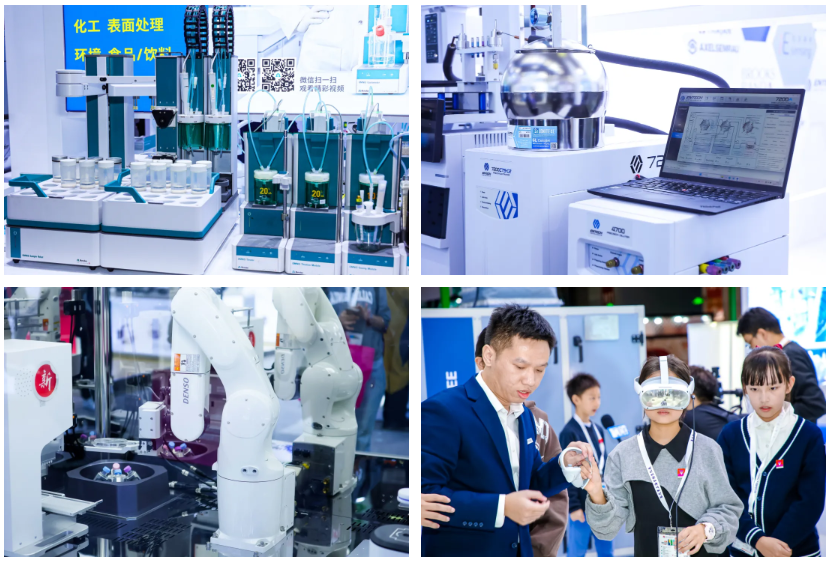
Laboratory equipment achieves interconnection through IoT and AI technologies. Researchers remotely monitor and control experimental processes via smartphones, VR devices, wearables, and other devices, significantly improving workflow automation rates. The widespread adoption of digital tools optimizes laboratory data management, while LIMS and cloud solutions enable more efficient collection, evaluation, and storage of experimental results.
Intelligent laboratories use robots and robotic arms to handle high-risk samples (pathogens/hazardous materials), reducing staff injury and sample contamination risks. Trace analysis employs non-contact operations to prevent contamination. It also supports 24/7 unattended operations to meet the surging demand for high-precision instruments in industries like new materials and new energy.
Guided by the "carbon peaking and carbon neutrality" goals, the laboratory field is accelerating the low-carbon transformation of the energy structure. Through the energy supply revolution, resource recycling reconstruction, and digital technology empowerment, laboratories are transitioning from high-energy consumption units to low-carbon scientific research hubs, driving the formation of a new development model that deeply integrates the "zero-carbon experimental chain" with "green knowledge production".
[Exhibition Scope]
● Laboratory automated equipment
● Laboratory automated liquid handling stations
● Laboratory automated measurement instruments
● Laboratory automation software and systems
● Laboratory digitalization and informatization
● Laboratory automated image processing technologies
● Laboratory data management solutions
● Laboratory information management system (LIMS)
● Electronic laboratory notebook (ELN)
● Robots and robotic arms
● Robotic process automation (RPA)
● Automation software
● Artificial intelligence
● AI algorithms
● Digital twin
● Others
[Application Areas]
Life sciences and medical research
Healthcare, inspection, and quarantine
Chemistry, chemical engineering, and materials science
Food and environmental testing
Teaching and scientific research
Agriculture and biotechnology
New energy development
Others
Life sciences and biomedicine
CRO
Pharmaceutical enterprises
Synthetic biology
Biotechnology
Medicine
Hospitals
Clinical diagnosis
Medical laboratories
Centers for disease control and prevention
Gene sequencing
Chemistry, chemical engineering, and materials science
Institutions of higher learning and research institutions
Food and agriculture
Third-party testing
Environmental monitoring and protection
Inspection and quarantine
New energy
Industrial manufacturing and quality inspection
Others